
Model the estate
Arrange the spaces you actually operate, place real hardware in the rack and keep names consistent from campus to cabinet.
Custom hierarchies · 7,000+ device types · naming rulesStart with the example. Make it your own.
Explore an editable example data centre: trace a cable from server port to switch, check rack power feeds, then make the estate your own. Export to NetBox or Nautobot when it is ready.
Sign in to open an editable example · no card required
One model, every physical layer
Arrange the spaces you actually operate, place real hardware in the rack and keep names consistent from campus to cabinet.
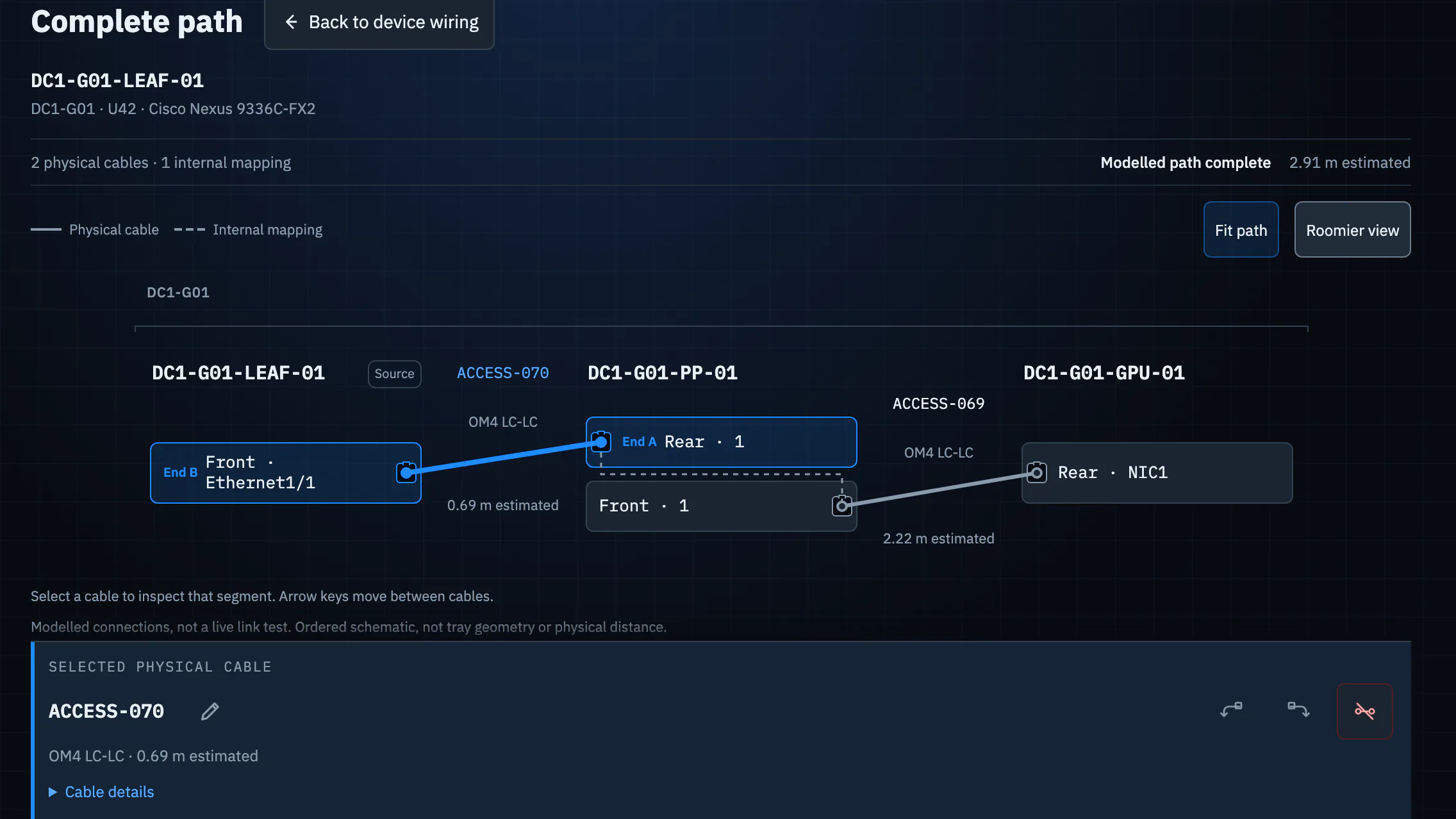
Custom hierarchies · 7,000+ device types · naming rulesUse Device wiring for exact ports, optics and custom interfaces. Follow physical cables and patch-panel mappings in Complete path, with broken continuity made obvious.
Structured cabling · patch panels · PDU feedsCatch power and cabling design smells while the plan is still cheap to change, work live with your team, then hand a validated physical design to NetBox or Nautobot as your operational source of truth.
Inline review · live presence · DCIM exportEarly access — Community stays free. Paid checkout is being prepared.
Community is permanent. Individual and Team show the annual-first pricing we're preparing; paid checkout is not live on this deployment yet.
A real starting point, not a cut-down trial.
Paid checkout is not available yet. Start on Community today.
For the solo designer.
Paid checkout is not available yet. Start on Community today.
For teams designing together.
Shape Railyard with us.
Passwordless sign-in, role-based access, and an Enterprise path for scoped private deployment.
A one-time 6-digit code sent by email, or your Google or GitHub identity. No Railyard password to remember.
Sign in with Google or GitHub, with owner / editor / viewer access control. SAML/OIDC federation to your own identity provider is planned for Enterprise.
Organisation access and plan limits are enforced server-side, with owner, editor and viewer roles.
Enterprise customers can scope identity, deployment, upgrades and support requirements with us.
No analytics or ad scripts — one strictly-necessary session cookie.
Railyard ships an MCP server, so Codex, Claude, Cursor and any other MCP client can read and edit your estates directly — “add a spine switch to rack A03”, “what’s the power draw of DC1?”, “export this to NetBox”. Run npx -y railyard-mcp auth to open Railyard in your browser, create a token under User settings → API tokens, then use the install command for your client.
codex mcp add railyard --env RAILYARD_TOKEN=ry_your_token_here -- npx -y railyard-mcp
Run npx -y railyard-mcp auth first to open Railyard, then create a token under User settings → API tokens. Need Codex? Install it with curl -fsSL https://chatgpt.com/codex/install.sh | sh. Verify with codex mcp list.
Swap ry_your_token_here for a personal access token from User settings → Personal access tokens. It authenticates as you, so treat it like a password. Full setup guide →
Design in the browser and collaborate in a shared organisation. Passwordless sign-in, hashed credentials, tenant isolation and no third-party trackers protect your work. Private-deployment, identity, upgrade and support requirements are scoped through an Enterprise agreement.
Sign in with a one-time 6-digit email code, Google, or GitHub. Owner, editor, and viewer roles are available. SAML/OIDC federation to your own identity provider (such as Okta or Entra ID) is planned for Enterprise; it is not available on the hosted service yet.
Private deployment is scoped through a separate Enterprise agreement. We agree identity, security, upgrades and support requirements with each design partner rather than treating self-hosting as a self-serve checkbox.
Yes. Plan and validate the physical layer in Railyard, then produce one-click structured export bundles for Nautobot or NetBox — real data, not screenshots — ready for your operational source of truth.
Yes. Community is free forever and needs no credit card. It includes one editor, one active estate, up to 5 racks and 100 devices, core rack, cabling and power modelling, read-only sharing and portable exports.
Passwordless authentication with hashed credentials, role-based access control, and tenant isolation between organisations — with no third-party trackers. See our Security page for the full detail.
The planned Team price is £690 a year or £69 monthly, including 3 editors and unlimited viewers and reviewers. Additional editors are planned at £150 a year or £15 monthly. Paid checkout is not live on this deployment yet.
Your whole estate — custom spaces such as sites, rooms and cages, racks at any level, and the devices inside them — with structured cabling and circuit tracing, power and thermal budgets, and a built-in library of 7,000+ real hardware models.